
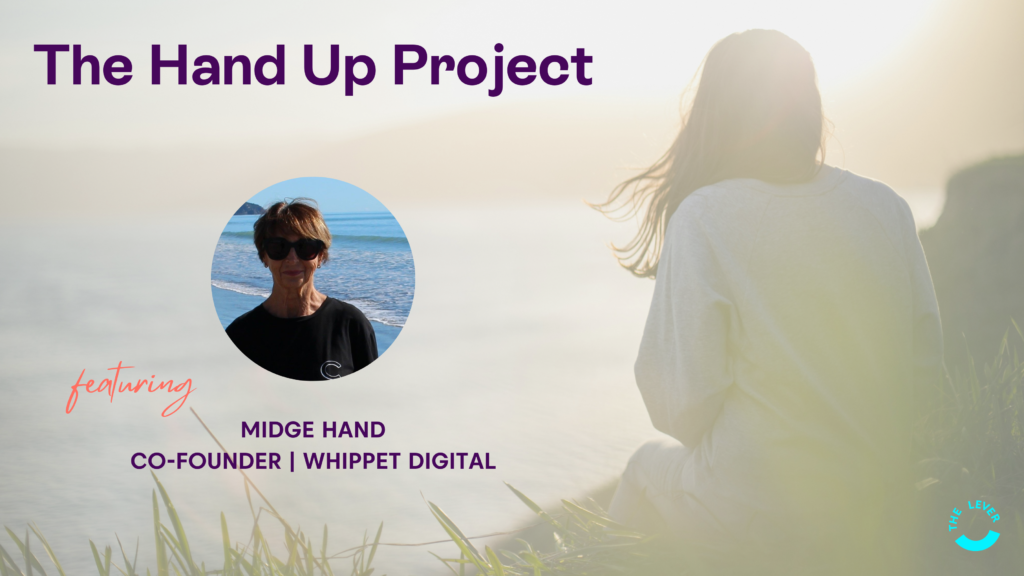
The Hand Up Project
Midge Hand, Co-Founder
WHIPPET DIGITAL
This International Women’s Week, the air is thick with talk of leadership and empowerment. But often, the most radical act a woman in business can take isn’t a grand public gesture it’s the internal decision to stop proving her worth through constant doing and start trusting her own compass.
With sixteen years of grit under her belt, Co-Founder Midge Hand of Whippet Digital has navigated everything from making herself redundant to protect a colleague’s dream, to steering an agency through massive technological shifts. Her story isn’t just about survival; it’s about the art of firing yourself from the day-to-day to make room for the intuition that actually grows a business.
Below, Midge shares her honest take on why you already have your seat at the table, how to move from doing to leading, and why your gut can be a better data point than a spreadsheet.
What originally inspired you to start your business, and how has that initial motivation evolved?
I was kind of forced into I guess. I was working as General Manager for a high-end fashion label, and due to environmental factors such as people buying clothes online and the fashion industry becoming commoditised, I made myself redundant to prevent the owner/designer from having to close the business. Following that, because I was living with my husband on a lifestyle property and commuting to the city daily for work, I decided it was time to reinvent myself and work for myself.
I have always been interested in health and wellness, so I started selling health products online for an Australian company. I did this for about 12 months, didn’t sell much but learnt a lot about the online space.
From there, I co-founded our online digital agency with my husband, and the rest is history.
What problem does your business solve better today than when you first began?
I have learned so much over the sixteen years, and one thing I know I am better at today than when I first started is listening. Really listening with intent and full attention, setting aside my own agenda, is quite an art. I listen to what clients are saying, what they are really saying (a bit of psychology and intuition is required here).
From these discussions, I gain a deep understanding of their business, which enables me to create a strategy that helps them solve their problems and achieve their goals.
What operational change or system had the biggest impact on your ability to step out of the day-to-day?
There have been several over the years and one operational change I made was working with a Business Operations Manager to get the systems and processes organised. This was of huge value and altered how our daily work is done, how knowledge is transferred and how the team is supported in their roles.
This has created consistency, freed up time and enabled scalable growth by reducing the business’s dependence on individuals.
Another change that has had an impact was implementing a business mentor and also working on a growth programme to scale the business. This has made us very focused on all aspects of the business, including our ICP, target market, systems, processes, sales, and leadership, among others. As part of this programme, we have developed a Manifesto which is essential for our team to buy into before they sign on.
What internal shift or mindset change has most transformed the way you lead?
"I think, after facing head-on some of the many challenges running a business presents, one of the most transformative mindsets in leadership has been to learn to back myself and go with my gut feeling."
This isn’t always easy! Logic presents itself, fear of failure sits on your shoulder, and everything except your gut feeling, or intuition seems to scream NO! Every time I haven’t trusted my intuition, it has been a wrong move. And every time I have trusted and backed myself, it has been the right decision.
Trust yourself, have faith and even if the move doesn’t work out, it’s okay! That’s business and it’s the failures and the successes that transform you into the leader you want to be, almost organically.
What was a turning point or decision that significantly accelerated your business’s growth?
The best move we made was to narrow down our niche and stop being a generalist Agency. It meant making some hard decisions, turning down work, and leaving some clients behind.
But… it’s been transformational for our business. New partnerships have sprung up, the team is excited and motivated by the change, and we now have a solid team of A players committed to our goals. We are excited about the transition, even though it has created considerable work. We have a proven blueprint to follow and a clear path ahead.
What challenge did you not see coming, and how did you navigate it?
Over the last 18 months, with a change in political power, the business sector has experienced a general downturn, driven by high inflation and interest rates that have reduced consumer spending. Businesses have struggled as customers have closed their wallets. This financial pressure has led to a rise in business liquidations among many long-time owner-operators who, sadly, have been unable to maintain their businesses. Many “kiwis” are leaving our shores to take their skills overseas, in the knowledge that they have greater earning power and that the recruitment field is larger. Unfortunately, they have removed many skilled people from the market. No one saw this coming.
Navigating this required tenacity, becoming lean and very focused on where the business was going, cutting back where possible, and having a mindset that recognises the business is cyclical and that things do turn around. Patience and trust are the attributes needed to ride out the storm.
What role, hire, or support made the biggest difference in how your business operates?
We hired a Google Ads Specialist about 12 months ago. Apart from being very experienced in his field, he is definitely an A player. He not only has advanced skills in his field, but he also brings innovation, strategy and a forward-thinking approach to everything he does. He is a valuable asset to the team and clients.
"I have learned to approach hiring new staff with the view that they need to know more than me."
This translates into innovative thinking, accelerated growth, improved operations, and gives me the freedom to focus on building a stronger company that can evolve faster. It does require putting ego aside and trusting others’ expertise, but the payoff is that I learn more, make better decisions, and create a high-performing team, making my job easier and the business more successful in the long term.
What advice would you give to other female founders working to move from doing the work to leading the business more effectively?
- Fire yourself from the daily operations in your business!
- Hire people better than you!
- Spend more time working on the business than in the business.
It is clichéd, but it’s true. Moving from “doing” to “leading” is paramount for effective leadership. If you have the mindset that your team can’t do the job as well as you, it’s either time to evaluate your team or embrace that perfectionism is a bottleneck.
Don’t tell people how to do the work: tell them the outcome you expect and then let them decide how to achieve it. It challenges them and gives them an opportunity to bring their best selves to the table. If they can’t do that, you have to evaluate if they should be in the team.
What shift do you believe female founders are uniquely positioned to benefit from right now?
I have experienced this personally as the Co-founder of Whippet Digital. Less than twelve months, I realised even though our business was performing well, the way businesses were being discovered was changing. AI was starting to sit between buyers and search, and being great at execution alone wasn’t enough. There was no single metric that indicated change – it came from noticing patterns and small signals. Acting on that meant repositioning the business around strategy and discovery rather than just channels.
I think female founders are well-positioned for this moment. In my experience, many of us are good at noticing what’s changing early and trusting our judgment before the data fully catches up. And as execution becomes easier and more commoditised, that ability is becoming the real advantage.
What’s one thing you wish more founders understood about building a sustainable, long-term business?
It takes time, constant re-evaluating and the courage to make hard decisions.
"You can't build a sustainable business by doing what you have been doing."
It comes from taking the time to step back and ask different questions, like, is the way our business is growing still the right shape for the current environment? Do we need to change direction/reinvent?
At Whippet Digital, some of our most strategic decisions were about changing direction even while things were going well – not because something was broken, but because the environment had changed and we had to adapt to new paradigms.
