The Hand Up Project
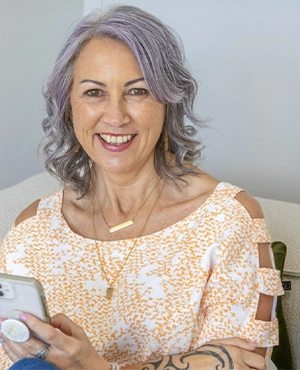
Sandra Julian Founder, Business Coach, Mentor
Some founders know Sandra Julian as the woman who built a thriving events business over 25 years. We know her as the client whose SOP library became, in her own words, “a thing of beauty.” What both versions have in common is a woman who learned, slowly, honestly, and sometimes the hard way, that the business you build is only as strong as your willingness to get out of the centre of it.
Sandra didn’t start with a grand vision. She started with a conversation, a colleague who spotted an opportunity, and a set of complementary skills between them. What followed was a quarter century of building, refining, letting go, and eventually stepping back entirely … not because the business failed, but because it was finally ready to run without her.
Then COVID arrived and took everything overnight.
What Sandra did next says everything about the kind of founder she is. She stayed curious, observed closely, backed herself, and delivered a virtual event to 750 people before most of her competitors had figured out their tech stack.
She sold the business 18 months ago. Now she coaches others through the exact transitions she lived. Her answers in this series aren’t theory, they’re the map she wished she’d had.
What originally inspired you to start your business, and how has that initial motivation evolved?
That feels like a lifetime ago. It began with a conversation with a work colleague over 25 years ago. It was her idea, and she could see a growing demand for business support services in the community. Between us, we had the skills to meet that need.
What started as an opportunity to provide practical support evolved into a long-term journey of building, leading, and eventually stepping back from a service-based business.
What problem does your business solve better today than when you first began?
I sold my business over 18 months ago, and today I provide coaching and mentoring services grounded in 25 years of leading a service-based business.
When we first started, we delivered what would now be called operations management, though at the time we referred to it as management support services. We quickly expanded into event management and communications.
Today, my work is focused on supporting business owners to lead more effectively, drawing directly on lived experience rather than theory.
What operational change or system had the biggest impact on your ability to step out of the day-to-day?
It took me some time to realise this, but the most significant shift came from reducing our service offerings. Over several years, I intentionally removed management support services, stepped away from communications work, stopped taking on community and sporting events, and chose to specialise in business events, specifically conference management.
"This focus allowed us to clearly document our systems and build a culture of ‘followed by all’. That was the point where I could gradually step out of managing and move fully into leading my team."
What internal shift or mindset change has most transformed the way you lead?
This was a biggie for me. I first had to see myself as a leader and consciously work on changing my internal identity. Once that changed, everything else followed. I stopped focusing solely on problems or missed steps and started seeing the potential in my team.
That shift fundamentally changed how I showed up as a leader and how the business operated.
What was a turning point or decision that significantly accelerated your business’s growth?
The turning point was when I trusted myself. For so long I was looking externally for the answers. Never thought I was as good as my competitors – I thought they knew more than me because I was self taught.
It wasn’t a single moment, but a gradual shift, one thought at a time. Instead of asking, ‘How should I do this?’, I began asking, ‘How would I like to do this?’ or ‘What would I like to have happen?’ That change accelerated everything.
What challenge did you not see coming, and how did you navigate it?
Wow! I didn’t see COVID coming at all! One day I had a business and the next day it was gone. We lost all our contracts literally overnight!
That could have been the end. But at the time I was already exploring innovation in conference management and looking at what the top business event managers in the US were doing. When COVID hit they quickly pivoted to online events. So I attended US events in the middle of the night and observed closely what they were doing and how they were doing it. I considered myself pretty tech savvy and quickly figured out what tech stack I needed to deliver online events for our clients.
I approached a few clients and floated the idea, two of them trusted in me and my team and we delivered our first two virtual events, one with over 750 people in attendance. From there, word spread and new opportunities followed.
What role, hire, or support made the biggest difference in how your business operates?
This is difficult to narrow down to one, as it changed at each stage of growth. Early on in our business journey, hiring an administrator made a huge difference by taking care of the small, routine but essential tasks.
Hiring my first Event Manager allowed me to step back from delivery and lead across multiple events.
Later, bringing on an Operations Manager to document and manage systems was critical.
Each role mattered at the time it was needed, which reinforced for me that the right hire depends on the stage of the business and what responsibility needs to be delegated next.
What advice would you give to other female founders working to move from doing the work to leading the business more effectively?
I believe it’s important for founders to understand all aspects of their business, and clearly identify all the roles and responsibilities required for it to operate well – even though the founder might be fulling all the roles.
"As the business grows, people can then be intentionally hired into those roles. Slowly but surely this allows the founder to move from doing the work to leading the business."
This was something I wish had understood much earlier in my business journey. It’s a very different way of thinking about building a team and it supports a much faster and more sustainable transition into leadership.
What shift do you believe female founders are uniquely positioned to benefit from right now?
I believe female founders are uniquely positioned to benefit from shifting away from constantly proving themselves and towards trusting their own judgement and lived experience. Many women have deep intuition, pattern recognition, and relational intelligence, but have been conditioned to second-guess it.
Right now, the shift is about valuing that internal knowing as a leadership strength, not something to override with more external validation.
What’s one thing you wish more founders understood about building a sustainable, long-term business?
There are a couple of things. Firstly, many founders think systems will box them in or take away creativity. In reality, well-designed systems are what create freedom. They allow the business to run without relying on the founder’s constant involvement, which is essential if you want longevity rather than burnout.
And, a sustainable business requires the founder to eventually step out of being the centre of everything. You can’t lead a business effectively while also being the one holding every task, decision, and relationship.
Long-term success comes from consciously transitioning out of doing and into leading, even when it feels uncomfortable at first.