
The short answer
You can’t take time off because the business still routes its decisions, questions and approvals through you. The missed holiday is the symptom. The root cause is that nobody else owns the work, so when you do step away, the work waits or the phone rings.
The question
I've booked the time away. Why am I working when I should be on holiday?
Founders ask us some version of this every week.
One founder told us she took a week off and told no one. Not her team, not her parents, not her kids. She got dressed, drove out like any other morning and sat by the water with a coffee. For a week! The moment people know you have space, they fill it, so the only way to get time of her own was to let everyone believe she was still at her desk.
That is not a time management problem. That is a business that has no way of running without you in the room. It’s not a discipline problem. You didn’t fail to switch off. The business simply never learned how to run without you, and that is fixable.
The problem
Don't treat the symptom
The usual advice is to switch off notifications, delegate more, or be more disciplined. It rarely holds, because it sits on top of the real issue.
| What you’re seeing | What it’s usually telling you |
|---|---|
| “Quick questions” arrive while you’re away | Decisions and standards live in your head, not somewhere the team can use |
| You fix problems yourself because it’s faster | Nobody has the authority to make the call without checking with you |
| The team goes quiet or stalls when you’re out | Work is assigned to people, not owned as an outcome |
| You feel guilty taking the time | The business has taught you that you are indispensable. That is a trap. |
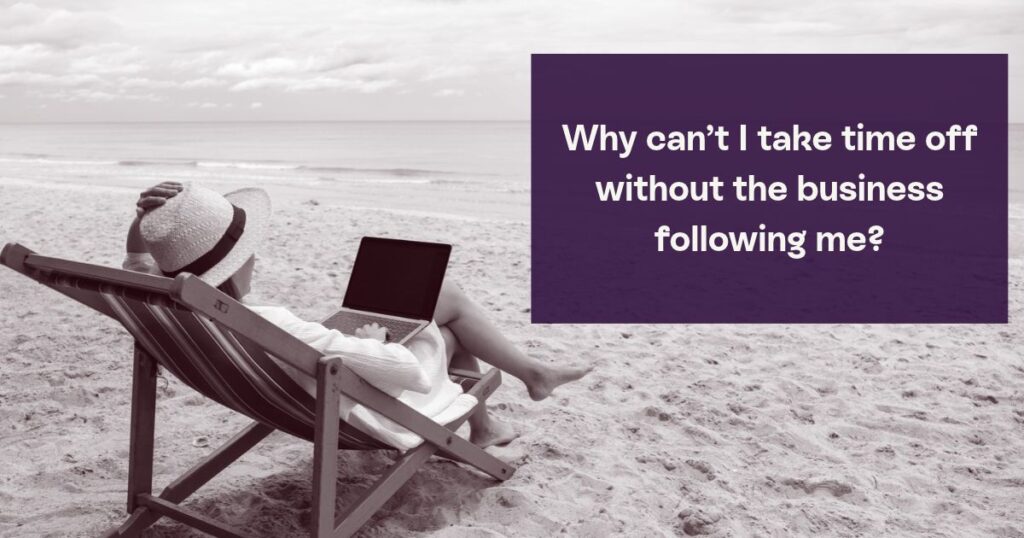
Our own founder, Justine, lived this at her previous business, a seven-figure agency. She was on holiday, laptop on her knee, answering “quick questions” and fixing client problems from the pool while her husband sat beside her, waiting out the “just another half hour” she kept promising. The business looked like a success. It had actually become a job she couldn’t quit. We cover the structural version of this in Why the work keeps coming back.
The business never learned how to run without you.
The solution
Build the business so it doesn't need you in the room
Freedom is a result, not a habit. It comes from three changes, and we see the same three in every founder-led business we work with.
1
Sort the decisions
Most founders find that a large share of the “urgent” questions are decisions the team could make with a clear rule.
2
Give each one an owner
Not a task, an outcome. The owner knows what good looks like and has permission to act without asking.
3
Move the knowledge
A single place for projects, standards and answers, so the team’s first stop isn’t your inbox.
In one 12-month partnership with two agency directors, every client meeting, kick-off and review ran through them and strategy kept waiting. The changes were minimum standards for when work starts, a team structure with clear authority and one source of truth for projects. Their goal was a fully unplugged holiday, and you can read how it played out in the Operations Restructure case study.
AI tip
Find your "only me" list this afternoon
Before you restructure anything, find out what is actually landing on you. Take a typical week of your sent emails and team messages, remove client names and personal details, and paste them into an AI assistant with a prompt like this:
Sort these messages into three groups:
- Decisions only I can make
- Decisions someone else could own if I gave them a clear rule
- Questions a written answer would have solved.
For group 2 and 3, suggest the rule or document that would remove the question.
Groups 2 and 3 are your first handover list. One caution: only paste what you are comfortable sharing, and check how your tool handles data first. The Privacy Commissioner’s guidance on AI and the Information Privacy Principles is a good starting point, and our own AI policy shows what we do.
Questions founders ask us
Isn't this just delegation?
No. Delegation hands over a task, and the task usually comes back. Ownership hands over the outcome and the authority to make decisions about it. That is the difference between a team that checks with you and a team that gets on with it.
How long until I can be properly offline?
It depends on how much sits in your head today and how big the team is. The first step is a 90-day plan that shows what to move first. We cover this in a 90-minute 90-day roadmap session, which can stand alone or lead into ongoing support.
What if my team isn't ready to decide without me?
Usually the gap is clarity, not capability. People hesitate when they don’t know where their authority ends. EOS describes the same pattern as a Visionary forced to play the Integrator role, because nobody else has been put in the seat: EOS Worldwide on the Integrator role.
Do I have to hire someone to fix this?
Not always a full-time hire. Someone has to own the day-to-day running of the business, and that can be a partner who plans the work, puts it in the right hands and sees it through. We explain what that looks like in What does a Business Operations Manager actually do?
Ready for a holiday that is a holiday?
You don't need the full plan. That's what the first conversation is for. We'll work out where the work is getting stuck, and whatever you decide afterwards is entirely up to you.