
Your team is already using AI
Let's make it work for you.
That's time saved and work moving faster. It's also client information and your IP going places you can't see. We build the rules into the tools your team already uses, so you get more of the upside, without the guesswork.
Not sure where you stand? > Take our free Governance Gap diagnostic.
You didn’t decide how AI is used across your business.
It just evolved.
A tool here, a shortcut there. Someone drafting proposals in ChatGPT, someone else summarising meetings in an app you’ve never heard of. All with good intentions, because AI makes their work faster and they’re trying to do a good job. You want them to be leveraging AI.
That’s not the problem. The problem is that nobody’s leading it. There’s no shared standard, no clear line between what AI can touch and what has to stay human, and no one whose job it is to keep it current.
And you already know it needs sorting. You just haven’t had the time, or the right people to build it.
What we see in businesses like yours
Not the headline risks. The quiet ones, already happening.
It starts with what you can’t see. Nearly half of people using AI at work do it through personal accounts, outside anything the business can see. Someone pastes a client’s name and situation into a free tool to save ten minutes. The Privacy Act already applies to that.
Then there’s what walks out the door. Not just client data. Your IP: your frameworks, your thinking, the way you work. A paid personal plan doesn’t automatically protect it. And your bookkeeper, your designer and your VA are using AI with your information too. Do you know what goes into their tools?
Then the work itself starts to shift. AI sounds sure of itself, even when it’s wrong, and plenty of teams haven’t learned when to push back. Human review slides from “always” to “usually”. The work gets fluent and a bit hollow, and your clients sense it before anyone names it.
Ten people end up running ten versions of your business. Different tools, different standards, different calls about what gets checked. And with no one owning it, every AI decision lands on you by default. Which means it doesn’t really land anywhere.
Why it matters
We love AI. We couldn’t imagine running The Lever without it.
But we’re also clear-eyed. Not about AI itself. About what happens when it runs ahead of the people using it.
- Governed businesses use AI more, not less. Once the lines are clear, your team stops guessing and starts using it properly. That's where the real time back comes from.
- It protects your team, not just your business. Clear rules mean nobody has to work this out on their own, or carry the blame for a gap nobody closed.
- Your expertise is the product. AI is brilliant at the mechanics. It doesn't know your clients, carry your judgement or have your ideas. Your people do. Governance keeps the thinking, the judgement and the voice your clients pay for where they belong.
- You're responsible for the output, whatever tool helped make it. If something goes to a client and it's wrong, it doesn't matter that AI drafted it. It's still your work.
- Instructions are a seatbelt, not a lock. The tools can be set up to stop at the right places. But the person is the control. That's why governance is about people and habits, not just settings.
How we work
Not a policy in a drawer. A system your team uses on Monday.
We set the boundaries with you, once, not task by task. Then we build them into the tools your team already opens every day. Here’s what that looks like:
The conversation with your team.
The one that answers what they’re thinking but won’t say out loud. “Is this because you don’t trust me?” “Is my job safe?” This is where governance becomes something your team chooses, not something done to them.
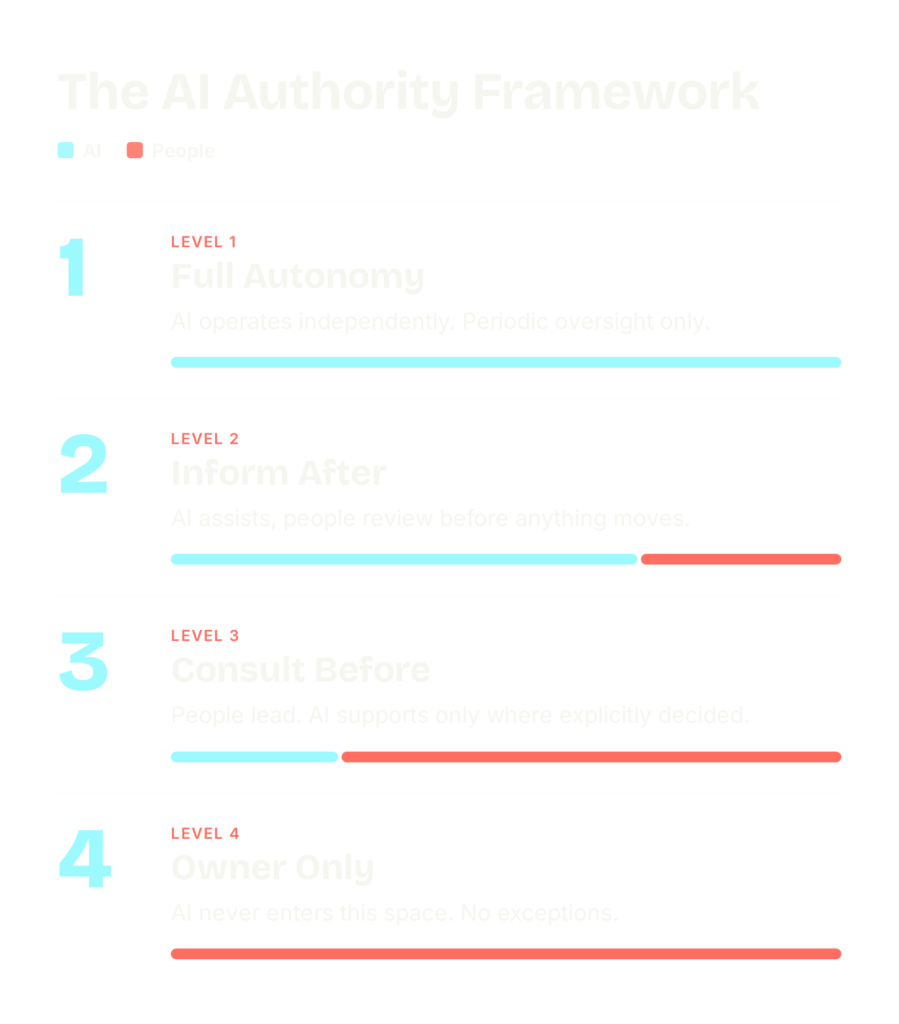
The AI Authority Framework.
Four levels: Full Autonomy, Inform After, Consult Before and Owner Only. What AI can do on its own, what it does with a person checking, where people lead and AI supports, and what it never touches.
Your Safe Sandbox.
The framework written into your own AI tool, whether that’s ChatGPT, Claude, Copilot or Gemini. So when someone opens a chat, the rules are already in the room.
One workflow, working better.
We pick one, new or something your team already runs, and make it faster and safer inside the framework before we finish. It’s the proof your team needs that governed AI is better AI.
A named AI owner.
Someone in your business who knows the system and can keep it current without us.
The Use Case Log.
What AI is approved for, who’s keeping an eye on it, the time it’s saving, and what your team does with that time.
Your path
Start wherever you are.
Free: The Governance Gap
Eight questions, five minutes. You’ll see where your business stands on AI risk, what’s working, and where you’re exposed.
Free: The AI Lever, your guide to AI governance
The system we built for ourselves. The Authority Framework, the Approved Tools Register, the Use Case Log, the quality checks and the team conversation guide. Everything you need to put this in place at your own pace.
Free: Your Initial Call
30 minutes with us. Tell us where AI is showing up in your business, and we’ll tell you honestly what we’d do next. That might be the guide, an Assessment, or nothing at all.
If you’d rather have it done for you.
Two steps. You only take the second if the first shows you need it.
The AI Assessment: NZ$3,000 + GST
We talk to your team, one-on-one, without you in the room. That’s where the honest answers are. Then we show you the full picture: where AI is creating risk, where it could be doing far more for you, and what to do first.
You leave with clarity you can act on yourself. Or, if you’d rather have it sorted, a fixed proposal for AI Installed.
AI Installed
We put the system in, everything in How we work, with your team. Led by a Business Operations Manager, with our specialists brought in where your gaps are. When we finish, your AI owner runs it without us.
Priced from your Assessment, plus GST. You’ll get a fixed proposal at your debrief, before you commit to anything.
Both start with your Initial Call.
Who it’s for
For leaders who can see the upside, and the exposure.
You’re a leader who can see what AI could do for your business, and what it could cost if it’s left to chance. AI is a lever. Governance is what lets you pull it hard.
You might recognise some of this. Everyone’s got a ChatGPT login, but nobody’s agreed how to use it as a team. You’ve asked for a human edit on everything, but it’s hard to tell how much AI actually did. You’re less worried about a data breach than about the work losing its soul. You can see AI taking over the routine work, freeing your team to do the work only people can do. And you know the rules need writing down. Nobody’s had the time.

Why The Lever
We’re not an AI specialist company.
AI governance isn’t a tech discipline. It’s an operational one. We’re a team of Business Operations Managers and specialists who use AI every day, across every part of the businesses we work in: finance, marketing, governance, tech, operations and people.
So we don’t just know the risks. We know where AI actually helps, where it quietly hurts, and what it takes to make it stick with a real team. We built this system for ourselves first. Then we installed it for others.
Our approach is People First. AI Forward. It’s the filter for every recommendation we make.

Frequently asked questions
It’s deciding, once, what AI can touch in your business, what needs a person to check it, and what it never sees. Then making sure everyone on your team works that way, every time.
No. A policy says what should happen. Governance makes sure it does: the rules built into the tools, someone who owns them, and a team that works that way every time. A policy on its own usually ends up in a drawer.
Not a standalone one in New Zealand. AI is covered by the laws you already follow, especially the Privacy Act 2020, which applies whenever personal information goes into an AI tool. Australia is moving faster. From 10 December 2026, organisations covered by the Australian Privacy Act must disclose when they use automated decision-making that significantly affects people. If you have Australian clients or operations, that may include you. This isn’t legal advice, so check your position with your lawyer.
Build the rules into the tool, so they’re there every time someone opens a chat. Organisation-wide instructions can tell your AI to stop when restricted information comes up. Then build the habit of using aliases instead of client names. But no setting is foolproof. A distracted person can still get past it. That’s why the conversation with your team matters as much as the settings.
It’s a good start, but it’s not the whole answer. Individual plans like ChatGPT Plus or Claude Pro can use what you type to improve their models unless you change the settings. Business and team plans generally don’t. And even the right account won’t stop someone pasting in something they shouldn’t.
Ask them how they use AI with your information, and whether their accounts train on what goes in. Then cover it, either in a policy they follow or in the contract they sign.
Client data and IP need different protection. For client information, leave it out: use placeholders like “Client A” instead of names and details. Anything a client has shared in confidence never goes in at all. Your own IP is harder, because you can’t anonymise a framework or a way of working. So protect it at the account level. Use a business plan where your inputs aren’t used for training, and make sure that work happens in the business’s account, not someone’s personal one, so it stays with you when people move on. Share only what the task needs, not the whole methodology. And hold your suppliers and contractors to the same standard, in writing.
AI defaults to average. Your voice comes from what you know, what you believe and how you say it, and AI only has what you give it. So start with your own thinking: notes, a voice memo, your opinion. Then use AI to shape it, not to come up with it. Give it examples of your writing, or a voice guide to work from. Keep a person on everything that goes out, and watch for the tells: too long, a bit fluffy, a little repetitive. If it doesn’t sound like you, rewrite it. One habit that helps: ask AI to make the strongest case against what it’s just told you.
Most policies don’t mention AI, and that usually means normal cover applies. Ask your broker two questions: are there any AI exclusions in my policy, and how would my professional indemnity and cyber cover respond if something went wrong? Every policy is different, so this isn’t advice about yours.
The Governance Gap diagnostic and The AI Lever, our guide to AI governance, are free. The AI Assessment is NZ$3,000 + GST. AI Installed is priced from your Assessment, with a fixed proposal before you commit.
Most installs take six to eight weeks. Your proposal gives you a fixed timeframe before you commit.
More AI. Less guesswork.
Whether you want to do this yourself or have it done for you, it starts with a conversation. We’ll listen, ask the right questions, and tell you honestly what we’d do next.